By: Jacob Paulsen
Major General Butler Buchanon Miltonberger, known as “Butts” to close friends, retired as a highly regarded member of the United States National Guard. From the Midwest to Northern France, Miltonberger achieved recognition for his leadership and courage. Despite an early retirement, his legacy is still relevant to the Guard today.
Born in North Platte, Nebraska, Miltonberger graduated from North Platte High School in 1916. Shortly after graduation, he joined Company E of the 5th Nebraska Regiment as a Private. He first served active duty at the Mexican Border in 1916 and returned to Nebraska as a sergeant.
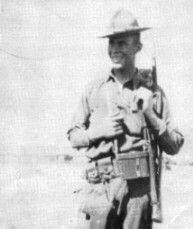
Upon his return, on July 15th, 1917, the United States drafted Miltonberger into federal service with his unit for World War I. The 5th Nebraska was redesignated as the 134th Infantry Regiment of the 34th Infantry Division. Miltonberger arrived in Europe in October of 1918 after most of his regiment had been split up to replace casualties. He was reassigned to the 4th Infantry Division shortly before the armistice and received his discharge from Europe on August 6th, 1919, ranking as a First Sergeant.
After the war, Miltonberger resettled in Nebraska, working in postal delivery and the state engineer’s department. However, he soon commissioned as a lieutenant into Company D of the 134th Infantry Regiment and was promoted to Captain in 1923. In 1933, he received the rank of Major and Commander of the 1st Battalion of the 134th Regiment.
Miltonberger first entered active duty as a commander during the Omaha Streetcar Riots and the Republican River Flood of 1935. The only first-responder unit during those emergencies, they prevented looting and assisted emergency response teams.
In another extraordinary act of leadership, he also personally captured convicted murderer Willard Brucks. On January 7, 1939, Brucks and two other men broke into the Omaha National Guard armory after escaping from a Cincinnati prison, intending to go on a crime and murder spree.
Coincidentally, that night, Captain Earl H. Kelso, his wife and Miltonberger went to the armory to check supplies. They heard noises and noticed an open door, and the criminals charged them. Despite blows from a crowbar and blackjack, Miltonberger single-handedly wrestled Brucks to the ground, took his crowbar and knocked him unconscious, the other two men escaping. The Omaha World-Herald deemed Miltonberger a hero.
Miltonberger’s accomplishments earned him a promotion to Lieutenant Colonel in 1940. Shortly before the U.S. entered World War II, Miltonberger was promoted again to Colonel of the 134th Infantry Regiment, now part of the 35th Infantry Division since its reassignment in 1921. During mobilization his unit trained at Ford Ord, Camp Luis Obispo, Camp Rucker, and Camp Butler.
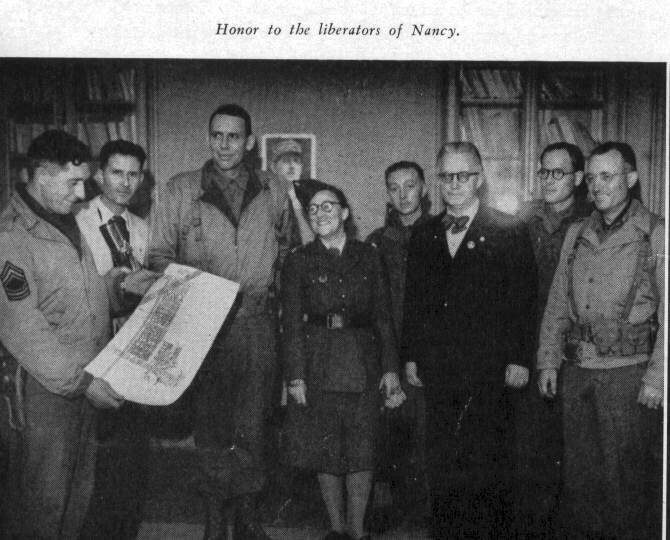
Miltonberger went overseas to England in 1944. The 35th Infantry Division landed at Normandy on July 3rd, almost a month after D-Day, and traversed through Northwestern France. Miltonberger led his men into the Battle of Saint-Lô on July 15th, aiming to secure this key crossroads to Central France for the Normandy Campaign.
By the time they had reached Saint-Lô, about half the regiment was comprised of Nebraskans. Taking advantage of the cloak of night and natural hedgerow cover, they advanced on the city. Utilizing tactical surprise rather than the cover of heavy artillery fire, Miltonberger and his men got a head start. The 35th captured Saint-Lô four days later, on July 18th. Despite taking nearly 1,000 casualties, they eliminated a major Nazi supply depot (Deeney).
The regiment continually embodied its motto, “All hell can’t stop us,” which was inspired by the 1st Nebraska Infantry Regiment during the Spanish-American War. Miltonberger continued to lead his men across the Vire River, the Moselle River, and eventually through Bastogne during the Battle of the Bulge. In February 1945, Miltonberger was promoted to Brigadier General. He returned to the United States in November 1945 following eighteen months in Europe.
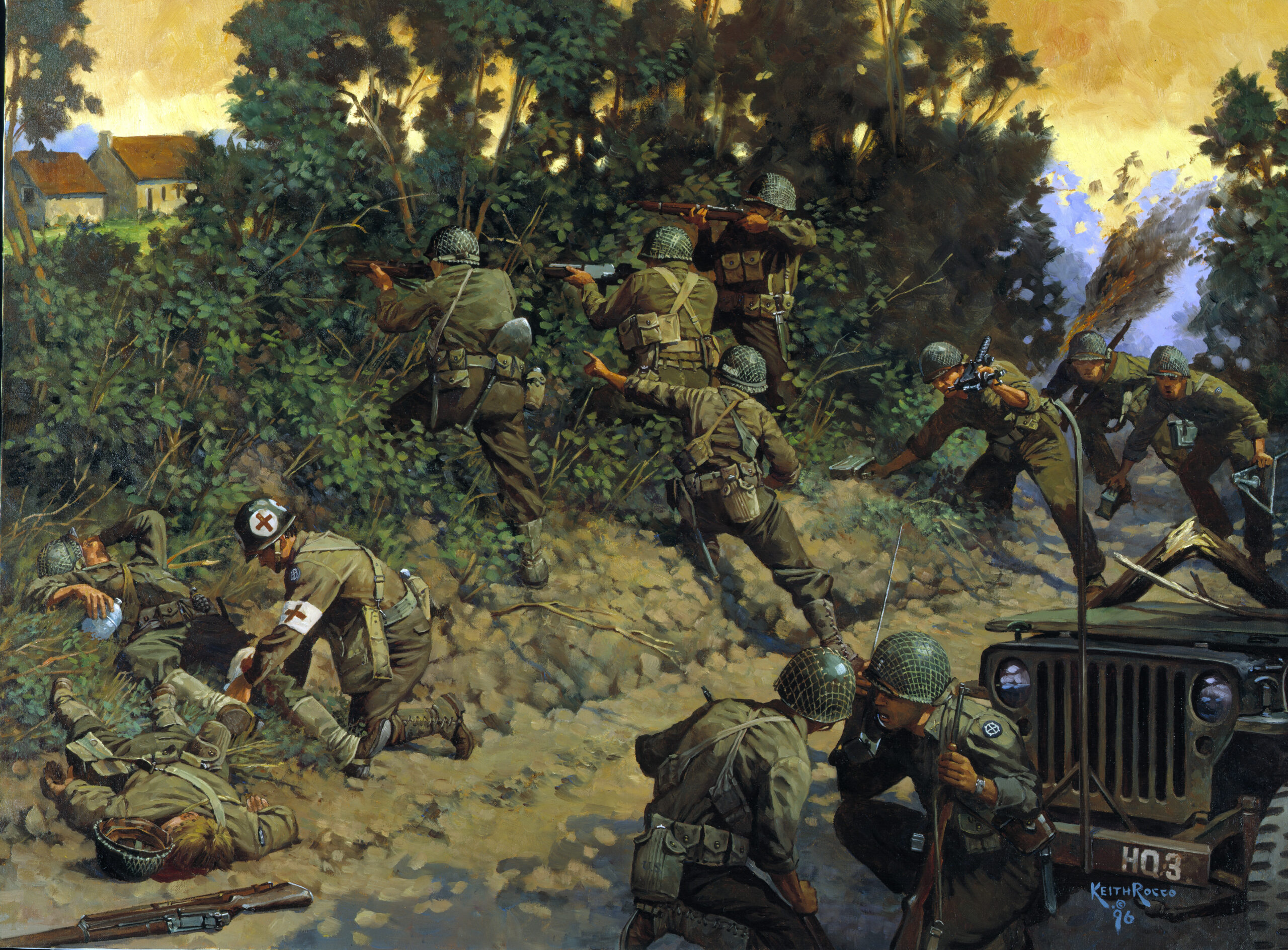
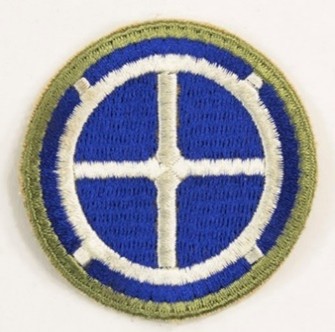
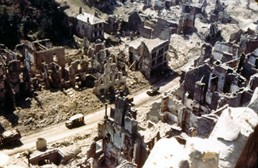
(Courtesy of Normandy1944info)
Recognizing his leadership and courage, the United States decorated Miltonberger with the Combat Infantryman Badge, the Army Distinguished Service Medal and the Silver Star among other achievements. President Harry Truman, a fellow veteran of the 35th Infantry Division, also recognized his value to the nation. He gave Miltonberger the title of Major General, and in January 1946 nominated him to become the first post-war Chief of the National Guard Bureau.
Miltonberger’s first focus as Chief became reorganizing the Guard following the World War II demobilization. This meant maintaining the Guard as a highly trained, equipped and deployable force to serve alongside the Regular Army. This concept of readiness and a standing belief in the National Guard was ahead of its time. Grappling with management and the freshly created Air National Guard, Miltonberger laid the steppingstones for the Guard to become what it is today.
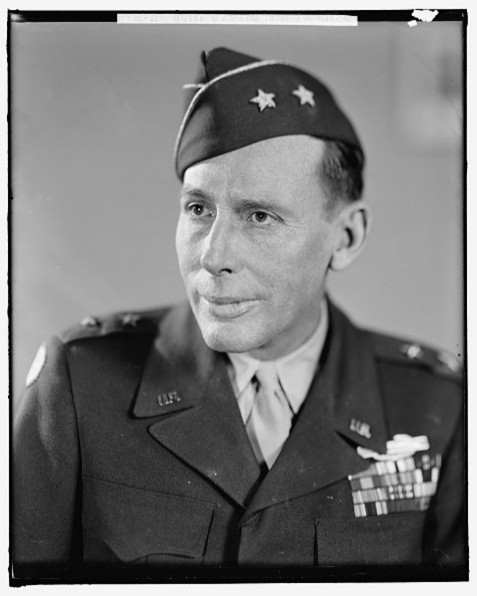
(Courtesy of Library of Congress)
Unfortunately, illness cut the illustrious and promising career of Major General Butler Miltonberger short. Only one year after he took his oath of office in February 1947, Miltonberger was forced to enter a hospital. He was then diagnosed with chronic sarcoidosis of the lungs and retired from active-duty military service and his position on August 1, 1947.
In retirement, Miltonberger returned to his hometown of North Platte, Nebraska. He continued to support the National Guard through the “Miltonberger Board.” This was a team of present and former National Guard officers reviewing the Guard Bureau’s structure and operating procedures. It supported the structure of the Air and Army National Guard under one bureau (Gross).
Though Major General Butler Miltonberger’s career was cut short, his ideas for the National Guard persist today. Symbolic of his legacy, the 35th Infantry Division is still part of the National Guard, which continues to be the most well-trained, equipped, and deployable reserve force in the world.